Read maps as maps
Chakras, nadis, doshas, and meridians can organize attention and practice without becoming anatomy proof or medical diagnosis.

Yoga, Ayurveda, and traditional body maps
Yogic Notions collects practice frameworks and Indian-lineage body maps as a careful reader’s guide. Use it for orientation, reflection, and better questions — not diagnosis, detox promises, or one-size-fits-all protocols.
4
topics
17
references
4
sections
Chakras, nadis, doshas, and meridians can organize attention and practice without becoming anatomy proof or medical diagnosis.
Routine, breath, ethics, study, touch, and seasonal adjustment are treated as steady self-observation tools, not guru certainty.
Historical and traditional sources matter, and modern evidence still shapes what the page can responsibly claim.
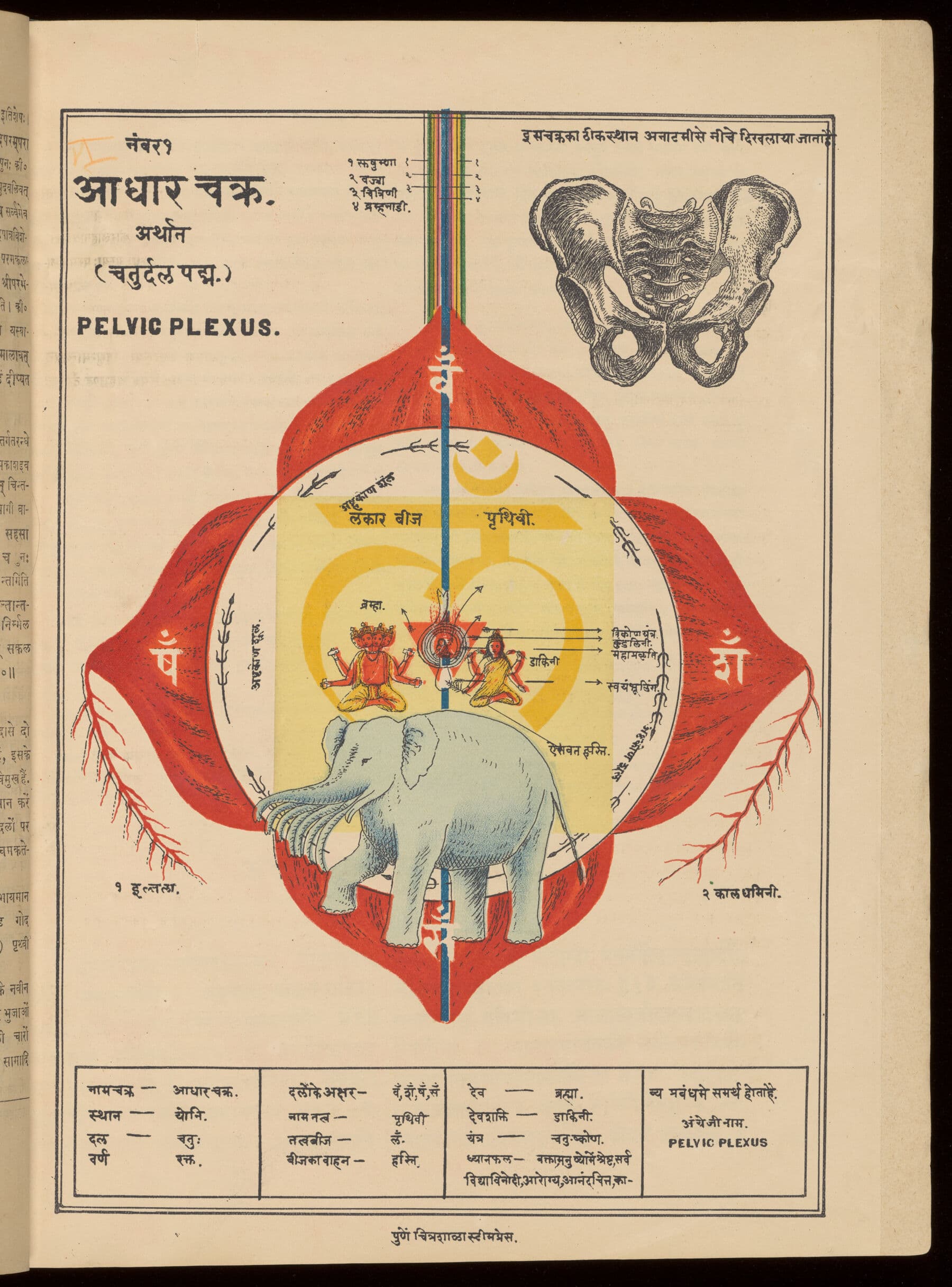
Source image: Wellcome Collection, Public Domain Mark, Shatchakra / Ṣaṭcakranirūpaṇacitram page from wellcomecollection.org/works/gfvqvfyf. Cropped for context; no endorsement implied.
Reading a historical subtle-body image
This historical Shatchakra plate layers lotus imagery, Sanskrit labels, deity symbolism, colored channels, English nerve-plexus language, and a small anatomical pelvis drawing. Read it as a practice map and translation object — not proof that chakras are literal anatomical structures.
01 / Historical map, not anatomy
Lotus forms, deity imagery, seed-syllable traditions, and channel diagrams are symbolic and pedagogical maps rather than modern anatomical structures.
02 / Hybrid labels
English nerve-plexus labels can reveal a translation bridge without proving a one-to-one equivalence between subtle-body maps and anatomy.
03 / Modern caution
Do not use a historic chakra plate to make disease, endocrine, pain, trauma, detox, or nervous-system-reset claims.
Ways to keep studying
Translations, commentaries, and yoga-history books that help separate source, practice, and modern interpretation.
Ordinary supports — mat, blanket, block, strap, cushion, notebook — only when they make reflection or practice easier.
Rights-tracked historical images can become annotated posters, cards, zines, or print-on-demand study objects after attribution is clear.
The foundations of classical yoga — ethics, lineage, and the philosophical roots that inform modern practice.
2 topics →
Research-backed insights into yoga practices, their mechanisms, and measurable benefits.
0 topics →
Traditional Indian self-care maps translated cautiously: doshas, digestion, routine, touch, and seasonal adjustment without guru certainty or medical overclaiming.
1 topics →
Acupuncture, meridians, manual therapies, and other traditional systems translated carefully into modern body literacy.
1 topics →
Section 01
The foundations of classical yoga — ethics, lineage, and the philosophical roots that inform modern practice.
Yoga Philosophy
The first two limbs of Patanjali's eight-fold path — ten ethical principles that form the foundation of all yoga practice. The Yamas govern our relationship with the world; the Niyamas govern our relationship with ourselves.
Read topic →
Yoga Philosophy
How one teacher in Mysore produced the major branches of modern yoga — Ashtanga, Iyengar, Viniyoga, and Vinyasa Krama — and why virtually every yoga class today traces back to him.
Read topic →
Section 02
Research-backed insights into yoga practices, their mechanisms, and measurable benefits.
Section 03
Traditional Indian self-care maps translated cautiously: doshas, digestion, routine, touch, and seasonal adjustment without guru certainty or medical overclaiming.
Section 04
Acupuncture, meridians, manual therapies, and other traditional systems translated carefully into modern body literacy.
Nearby tradition
Acupuncture and meridian maps sit near Yogic Notions, but they come from Chinese and East Asian medical cultures. Meridian Arts keeps that lineage visible instead of folding everything into one vague “Eastern wellness” bucket.